
Freedom—February 16, 2026—Freedom officials said they would provisionally forgo taking legal action against Wabanaki Campground after the business agreed to address long-standing environmental and zoning issues on the 11-acre Ossipee Lake property.
The apparent agreement between the parties has the potential to improve environmental protections for Ossipee Lake. That’s a goal that neighboring property owners and conservation groups sought during several years of debate about the future of the campground.
The agreement calls for Wabanaki to pay $137,500 in fines, $82,500 of which is for zoning violations. The town said it was treating the property’s multiple zoning violations as a single violation in the interest of trying to resolve the issue outside of court.
“Should the town be forced to litigate this matter, it will seek to collect statutory fines for each individual [zoning] violation…in the amount of $716,100,” the town said.
The additional $55,000 in fines is for violations of shoreline regulations. The town said the shoreline fines could be substantially reduced if there is timely remediation.
The agreement requires the campground to obtain an “existing conditions” survey from a New Hampshire-licensed surveyor. It also requires that a New Hampshire-licensed engineer produce a stormwater management plan.
Both plans are to be paid for by the business and appear to be subject to a third-party professional review, also to be paid for by the business.
In a key provision of the agreement, no improvements can be made to any part of the property, and no permits will be issued, until all violations of town law are remedied.
“Payment of a [fine] does not validate or authorize the continued existence of any structure, even if that structure was later properly permitted,” Freedom Town Counsel Matthew Serge wrote in a letter to Wabanaki.
“Treating payment as a form of retroactive approval would set a harmful precedent,” he added.
Serge thanked the campground for meeting with the town to address the issues. He called the agreement the “first step in a comprehensive process” to ensure compliance “for years to come.”
The campground did not respond to several requests to comment for this article.
Site Plan Application Sparks Review
The agreement with the town comes two years after Wabanaki applied to Freedom’s Planning Board to make improvements to the property in anticipation of converting to cooperative ownership.
Months of hearings produced evidence that some of the proposed improvements had already been made, and other violations had taken place over the course of several decades. Planning Board members allegedly found that runoff from the densely populated property was eroding the shoreline and emptying into the lake.
Wabanaki withdrew its application after the board concluded that so many changes were being made to the “current state” depiction of the property that it no longer knew what it was being asked to approve.
Wabanaki’s “hutnick” structures, which are small cabins, were integral to the Planning Board application. They were also a key part of the findings of the Zoning Officer, a State Mechanical Inspector and a State Electrical Inspector who jointly conducted a site inspection.
In its site visit report, the town said construction, alteration and expansion of the hutnicks had taken place without required permits. The report cited electrical hazards and septic system deficiencies, including improper venting, exposed wiring and missing backflow preventers.
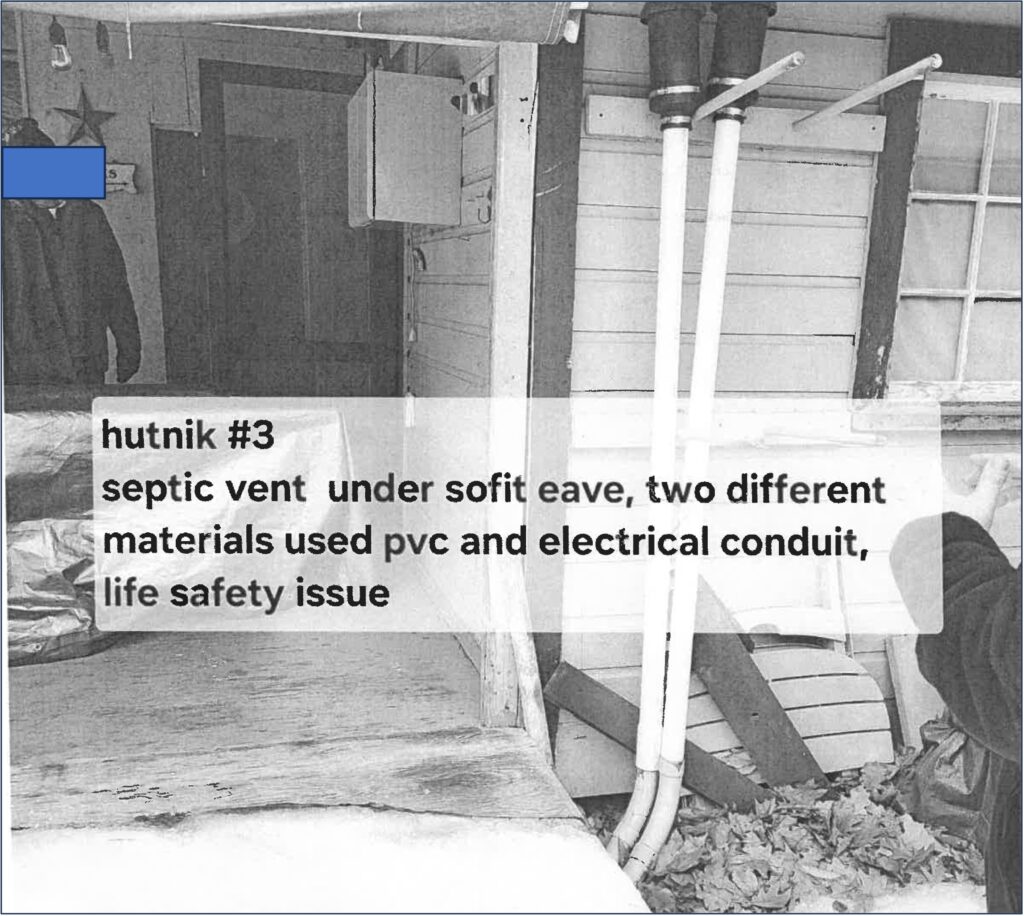
Officials have prohibited Wabanaki’s “hutnik” cabins from being occupied because of septic, electric and structural deficiencies. Photo and caption: Town of Freedom
The report noted that the number of bedrooms in several of the structures exceeded the number authorized to be connected to the septic system.
Town officials additionally said that structural deficiencies in the hutnicks presented “serious life safety risks.” Officials said the hutnicks were “unsafe for occupancy” and required corrective measures “pursuant to RSA 155-A and applicable state building and health codes.”
The agreement with the town requires Wabanki to hire a licensed structural engineer to evaluate each hutnick for “salvageability or removal.” Salvaging the structures would require new town approvals.
Other zoning violations documented during the site visit include RVs that were replaced without approvals, and decks constructed without permits. A fourth apartment in the apartment building was found to be unauthorized.
The town said Wabanaki made a $17,500 down payment on the fines on January 27. Additional monthly payments of $14,000 are required to be made during the next five months.
The “existing conditions” and stormwater management plans are required to be submitted to the Planning Board by February 26 for review by the board at its March 19 meeting.
It’s good to see a plan which makes sense first to the environment second to abutters and third to integrity in planning engineering and conformity. I would think the town would appoint a committee to bi-monthly inspect for changes in the agreement; if there is one, report of no changes on prioritized work for conformity and questionable construction. Trust thru verification.
This is surprising and positive.