
Freedom ZBA Says Camp Cody’s Wedding and Conference Center Businesses Are Grandfathered
Freedom—August 26, 2026—In a brief meeting on Tuesday night, Freedom’s Zoning Board of Adjustment unanimously upheld Zoning Officer Bryan Fontaine’s decision that Camp Cody’s wedding and conference center businesses are “grandfathered” uses of the children’s summer camp.
While neither use is permitted on Camp Cody’s Ossipee Lake property, Section 901 of the Zoning Ordinance allows a prohibited use to continue as a “non-conforming use” if it predates the adoption of zoning in 1987.
Tuesday night’s hearing, which was a continuance of a July 28 hearing, stemmed from a zoning complaint by abutting property owners Sharlene and David Cahill. The Cahills said Camp Cody had expanded beyond its legacy children’s summer camp business to establish year-round commercial operations.
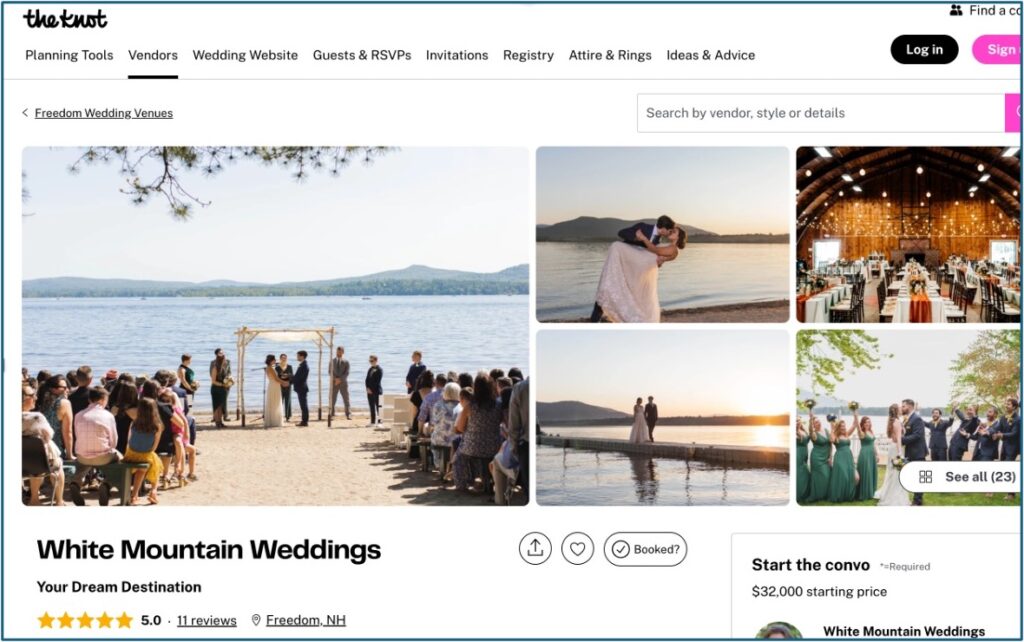
[A similar complaint by Ossipee Lake Alliance was dismissed for lack of standing, based on a change to State regulations last year].The Cahills identified the additional businesses as White Mountain Weddings and Lake Ossipee Conference Center/NH Retreat Center. Peter and Rachael Ross Holdings LLC obtained trade name registrations for the two businesses in 2023.
White Mountain Weddings promotes weddings of up to 500 people. The conference center website promotes “a home-away-from-home for organizations from around the world.”
The Cahills’ complaint said that Camp Cody’s public-facing commercial operations had increased traffic, noise, and trespassing—issues they said should have been addressed in applications to the town for approval of the operations. They told the town that the expanded uses were hindering their ability to enjoy their home.
Zoning Officer Fontaine responded to the complaint the same day to say the two businesses were grandfathered. He cited the Select Board as his source of information.
The Cahills appealed to the ZBA, which held a hearing on July 28. The couple’s attorney, Phillip Marbury of Marbury & Marbury, said the town had declined to provide his clients with evidence supporting Fontaine’s decision.
Marbury argued that the scope of the wedding and conference center businesses was substantially different from the property’s legacy use as a children’s summer camp, and had disproportionate impact.
Marbury said that even if there had been weddings and conference center activities prior to zoning, “substantial changes” had been made to those non-conforming uses, including this year.
DES records show Camp Cody in March tripled the size of its Dining Hall septic system from 5,000 gallons to 15,000 gallons. Its application to DES stated the increase was needed to accommodate “mutually exclusive” use of the system for commercial activities when the children’s camp was not in session, including a 250-person restaurant.
Zoning Officer Fontaine approved construction of the septic system expansion. The approval is stamped “For septic system setback only; does not relieve the property owner from seeking all other necessary local approvals.”
Cahill attorney Marbury said the septic system expansion should have been referred to the Planning Board for site plan review. He asked the ZBA to require Camp Cody to obtain all municipal approvals for the businesses.
“By treating the commercial uses as grandfathered, the Town has effectively removed the uses from ordinary zoning, site plan, shorefront, and regional-impact review,” Marbury concluded.
At the July 28 hearing, Camp Cody’s attorney, Christopher Meier of Cooper Cargill Chant, said the Cahills’ appeal should be dismissed as not timely.
He said the town had communicated its grandfathering determination on February 3 and May 12, and the 30-day appeal clock should have started then, not on June 3 when the Cahills received a response from the Zoning Officer.
Camp Cody Executive Director Philip Ross testified to the grandfathering issue. He said that off-season events, including weddings, conferences and scout activities had taken place prior to 1987. Facilities were constructed to support those events, he said.
Ross said Camp Cody provides important economic and educational benefits to Freedom and year-round employment.
He was echoed by camp employees Anna Gross and Angela Quint. Gross said events and parking uses predated her employment in 2001. Quint said restrictions on the businesses would harm employees and families.
Freedom Select Board Chair Les Babb told the ZBA he investigated similar complaints in 2000-2001 when he was the Zoning Officer. He concluded that there were weddings at Camp Cody prior to 1987.
The hearing was continued to this week so the board could consult Town Counsel Matthew Serge about whether the Cahills’ appeal was timely.
The board said it also wanted to know from Serge what evidence would be sufficient to establish historic use in regard to grandfathering, and what degree of expansion is permissible under non-conforming use law.
This Tuesday, after a half-hour non-public session, the ZBA briefly discussed the timeliness question and decided the Cahills’ appeal was timely. It then denied the appeal.
The board did not issue Findings of Fact for the case, and did not discuss the sufficiency of the evidence or the degree to which expansion is permissible under non-conforming use law.
After the hearing, Sharlene Cahill said “This is all about accountability, not about trying to shut down these two businesses.”
“The lack of town oversight has had an impact on us and on the environment. Camp Cody should be required to go through the same approval process as anyone else would have to go through in order to operate two commercial businesses of this scope, especially on the lake, ” she concluded.