
The Loon Guardians of Ossipee Lake
Freedom—September 27, 2026—You may have noticed that the loons of Ossipee Lake are flocking.
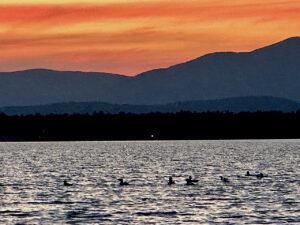
Despite their territorial nature, the change in season from summer to fall prompts these graceful birds to set aside their need for personal space and gather in groups before wintering on the ocean.
Those who regularly observe this seasonal phenomenon say it’s as if they were gathering to discuss how the summer went. A kind of end of season social celebration.
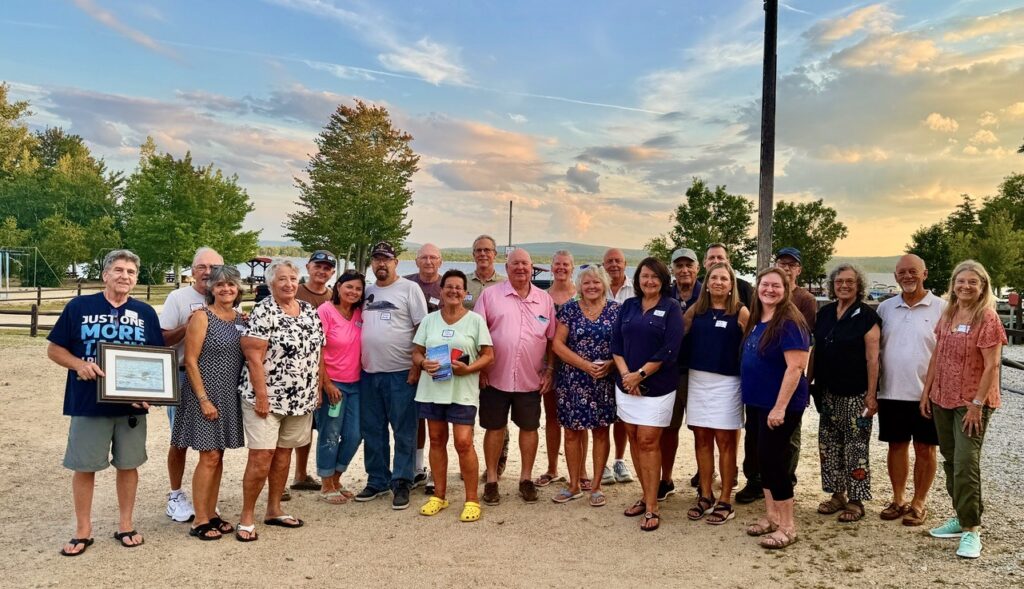
In that same spirit, a group of volunteer loon guardians gathered on the neatly-tended shoreline of the big lake’s Totem Pole Park on a balmy late August night to share a pot-luck dinner and take stock of the year’s activities.
They call themselves “Loonies,” and they come from every corner of the lake system. Seasonal and year-round residents, weekenders and regular visitors alike. All with an affection for loons and a commitment to protect them.
“I fell in love with these magnificent birds somewhere around 2000,” said Dennis Gould, at the pot-luck event.
Gould’s first volunteer effort was to help monitor nesting chicks. Then he began reaching out to others to help locate nests and protect them with ropes and signs.
Today, Gould is the go-to person for protecting Ossipee Lake’s loons. Known to all as the “Loon Guy,” he’s the liaison with state and local officials, conservation groups, and, most importantly, the Loonies.
Loonie Sue Shiels and her boyfriend, John Cummings, were with Gould at the Totem Pole Park meet-up.
“A change in our schedules means we can now spend more time on our pontoon boat during the week, when things are a little quieter and more peaceful,” Shiels said.
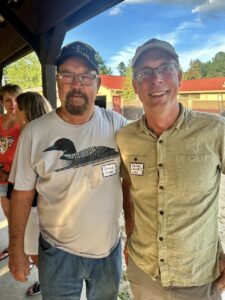
“We are usually on the water by 11:00 a.m., and it’s a contest to see who will be the first to spot a loon.”
Shiels said the early season plan is to slowly cruise around the lake and coves and search for nests. As summer progresses, the mission changes to finding chicks swimming alongside their parents.
Later in the season, the couple and their eight-year old grandson, Justin, look for those chicks to see how well they’ve learned to dive.
“We never get tired of searching, watching and enjoying these incredible birds in their natural surroundings,” Shiels said.
That kind of interest and dedication has been key to bringing loons back from the brink.
Loons were common throughout the state in the early 1900s. But by the 1970s they faced challenges caused by human activity, from acid rain and mercury to a significant increase in power boats.
By the time the Moultonborough-based non-profit Loon Preservation Committee (LPC) was created in 1975, the number of territorial loon pairs in the state was estimated to be just 74. That put the common loon on the endangered species list.
As LPC staff and volunteers began monitoring state lakes, they determined that Ossipee Lake had a handful of adult loons, but there was little successful nesting.
“When I was young, the lake’s loon population was practically non-existent, said Tracy Maidment, another Loonie volunteer at the Totem Pole Park event.
She said that after learning about their history and unique qualities, she realized why it was important to make the lake a safe habitat for breeding.
“When Dennis reached out for volunteers, I immediately knew I wanted to be involved,” she said.
Years of Progress
LPC Senior Biologist John Cooley said the Ossipee Lake loon population has come into its own during the past decade, thanks to the volunteer efforts Gould has organized for more than 25 years.
Seven breeding territories are now established on the lake. In some years, those territories have hosted as many as six active nests, hatching as many as six chicks with a maximum of four chicks surviving to fledge in mid-August.
“In good years, overall breeding success for the Ossipee Lake subpopulation has been above the statewide average,” Cooley said.
Two of Ossipee Lake’s nesting sites are the aptly named Loon Island in Leavitt Bay and Loon Island in Broad Bay.
Leavitt Bay’s Loon Island was purchased by the Town of Ossipee two years ago to prevent it from being developed. It is now a protected natural area with plenty of room for loons to nest.
Broad Bay’s Loon Island has long been owned by YMCA Camp Huckins, which uses it for low impact camp activities.
The camp’s Executive Director, Heather Kiley, said the presence of loons around the camp is something the Huckins community has valued for nearly 100 years.
“Falling asleep to the loon calls at night is as much a part of our culture as island swims and camp songs. We have had a loon nest on Huckins Island every summer since 2021, and we watch over the family throughout the summer.”
Kiley said the camp adapts its activities to protect the loon nests as needed, including steering clear of the island during nesting season. It has also canceled its annual fireworks display when nesting pairs are in residence.
“It’s always worth it once we see the baby swimming with its parents,” she said.
Threats Remain
LPC sponsors a statewide loon count at the same hour of the same day of the same month each year. Ossipee Lake’s Loonies are assigned specific bay and cove areas to search for loons and document sightings.
Although the results from the one-hour count can vary from the tally of resident loons for the season, care is taken not to misrepresent or double count. This year, 36 loon adults were counted during the census hour, with one chick and one active nest.
That was a disappointment compared to 2024, when there were 33 adults and five chicks. In 2025, there were 33 adults and six chicks, with one nest still active at the end of the count.
Active protection of loon nests is an evolving process, with the use of floating nest rafts now an established adjunct to deploying rope barriers and warning signs around nests near the shoreline. Then there are ancillary tasks like arranging the annual loon census and helping state biologists collect hatched egg shells for research.
Natural predators like eagles and snapping turtles are an ever-present threat, as are boaters, who are a danger when they come too close. Physical harassment of loons by boaters is rare, but is not unknown. That makes boater education an ongoing need.
Loons are also challenged by high or inconsistent water levels. This year’s fluctuating water levels may have delayed or deterred loon nesting, according to Gould, who said he was in touch with the N.H. Dam Bureau as the water level rose this spring.
He said a post-season review will be needed to understand how things played out in real time. He and others said they hope to meet with Bureau officials this fall.
The Change in Season
As for the loons currently flocking on the lake, the change in season will soon take them to the ocean, which will be their home from October through March or April.
Adult loons will be back after ice-out in the spring, typically returning to their previous year’s nesting site. The juvenile loons, however, will stay on the ocean for at least two years.
After maturing to adulthood, the new generation of loons will start looking for a lake to call home and a suitable mate to continue their lifecycle.
In the meantime, while Ossipee Lake’s loons flocked in preparation for winter, the Loonies gathered at Totem Pole Park to enjoy a meal and swap stories.
“People who had never met in person talked as though they were long-lost friends,” said Friends of Ossipee Lake President Gloria Villari, who helped organize the gathering.
“That’s the kind of camaraderie that happens when volunteers with the same goal get together to socialize,” she said.
Jackie Gerald is Assistant Resort Manager at Westward Shores, one of a number of volunteers from the lake’s campgrounds and children’s camps. She said she was thankful for the opportunity to be part of the group.
“Having spent the last nine years living and working on Ossipee Lake, loons have become not only a part of my job but also a part of my life,” she said.
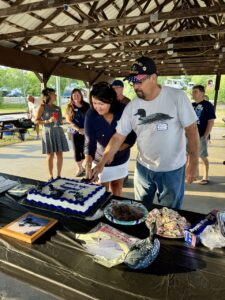
After the pot luck dinner, there was cake for dessert, a gift of appreciation to the Loonies from the “Loon Guy” himself. While Gould says he accepts the label, he’s quick to point out that he’s just a team member, and it’s the team that counts.
Friends of Ossipee Lake leader Villari echoed his thoughts.
“The Loonies are unique individuals and are individually unique. But they share an understanding that their strength lies in collaboration for a common good,” she said.
“That’s what makes this group so effective.”
To volunteer, call Dennis Gould at (617) 257-4847. A longer version of this article is here.
Comments (0)