
Freedom Select Board Grants Relief On Wabanaki Prohibition
Freedom—May 20, 2026—Freedom’s Zoning Officer last week said the Select Board granted Wabanaki Campground relief from a January mandate that no changes be made on the property until the business corrects long-standing environmental and zoning violations.
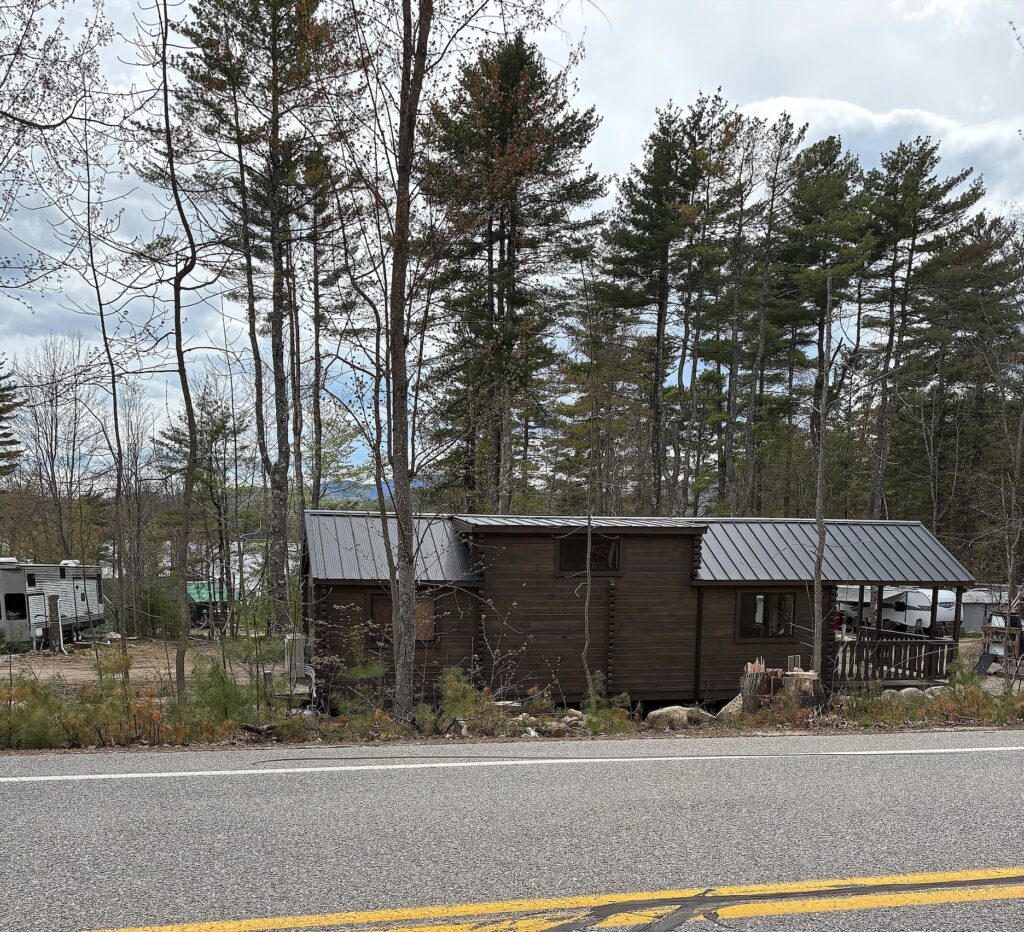
In response to a complaint that a new Park Model with a porch was installed during the first week of May, Zoning Officer Bryan Fontaine said the Select Board authorized the activity.
The town is “aware of what is going on,” Fontaine said. The Select Board “has allowed trailers to be placed into location.”
The Select Board did not respond to a request to comment on its approval of the installations or say when the decision was made.
In an email to Ossipee Lake Alliance, Wabanaki principal Mark Salvati said he moved a Park Model unit onto Site 64 and is planning a second installation on Site 39.
Town tax records show Site 64 had no previous unit or structure. The Site 39 installation would be a replacement unit, per public records.
Freedom’s approval of the installations comes four months after the town put a hold on all such changes until Wabanaki corrects long-standing environmental and zoning issues.
“I want to emphasize…that no further improvements may be made to any portion of the campground property, nor will any permits be issued, until the current violations are remedied,” wrote Town Counsel Matthew Serge of Drummond Woodsum in January.
In addition to being contrary to the prohibition, the installation of the Park Model is notable because such structures are designed for semi-permanent placement and require direct hookups to electricity, water and sewage.
Under New Hampshire law, a regular RV with utility hookups is legally assigned a septic design flow of 60 gallons per day (GPD) for four persons. A Park Model is generally evaluated at 150 to 225 GPD for the same number of occupants.
Since most Park Models can accommodate more than four occupants, however, the discharge can be even higher.
A review of public documents last year revealed that two of Wabanaki’s septic systems appear to be providing sanitary services in excess of approved capacity. DES reviewed the findings and said addressing any variances from approved plans is the town’s responsibility.
The septic system capacity issue was cited by the town in its January violation notice. Other violations included RVs replaced without approvals; decks, roofs and porches constructed without permits; and a fourth apartment impermissibly added to the apartment building.
The town also determined that Wabanaki’s “hutnick” cabins were altered and expanded without permits. After a N.H. Department of Safety inspector said the structures were unsafe, the Zoning Officer prohibited occupancy and said they must be evaluated by an engineer for “salvageability or removal.”
Wabanaki agreed to produce an engineered stormwater management plan and an “existing conditions” plan with “uniform numbering of the lots.” Per Town Counsel Serge, the plans must be reviewed for adequacy by a professional third-party before being submitted to the Planning Board.
Serge said an application to the Planning Board is required because the property has been “altered” from the subdivision plan approved by DES in 2001.
The two new plans were due on February 26 for a potential Planning Board review on March 19. Nothing has been presented to the Planning Board to date, according to town records.
The Zoning Officer declined to comment on the status of the plans, but campground principal Salvati said there has been progress.
“Things are moving along with the Select Board,” he said.
Comments (4)
Comments are closed.
These models are “campground ready” and have 50 amp service.
They are under 400 square Feet and on wheels.
There is nothing wrong with this park model. In fact, I wish there were more of them! They look so much better than traditional campers/trailers.
Well done, wabanaki!
It looks nice like the bunch of them that Cody did that no one cried about.
“Things are moving along with the Select Board” is the quote of the year.
getting Wabanaki to comply with state laws, the numerous code violations and their compliance with the selectboard is as easy as it is to get the state to enforce the rules of the OLNA , (it doesn’t happen)
There is nothing wrong with that park model. Hell, I think I’ll order one now too! Are you trying to protect the lake? Or are you trying to protect how YOU want the lake and your own personal interests? Town said ok. State said ok. You all cried. Get over it!