
Country Ecology: The Pied-Billed Grebe
Editor’s Note: Dave Eastman lived in Tamworth and was a prolific nature writer and friend of the lake. His work appeared here, on WMWV Radio and in the Conway Daily Sun. Before he died in 2019, he sent us a batch of essays that he thought the lake community would enjoy. We have been running them ever since. This short piece first ran on WMWV in the summer of 2020.
Throughout NH, the chunky pied-billed grebe can be commonly found on our watercourses, in all seasons—as long as it can find open water.
They expertly obtain their food underwater during foraging dives. They can propel themselves rather quickly with lobed feet, located at their rear ends.
These small birds eat mostly large crustaceans, which they capture and crush with their short, stout bills as they possess strong jaws within their blocky heads.
They are opportunistic feeders, consuming a great variety of prey, depending on whatever is available. These include crabs, shrimp, snails, mussels, beetles, dragonfly nymphs, and other aquatic insects and their larvae.
Pied-billed grebes might also go after leeches, frogs, and their tadpoles in some parts of their range. They can even devour tiger salamanders. Their most common fish prey are carp, minnows, catfish, sculpins, killifish, sticklebacks, gizzard shad, and sunfishes.
Pied-billed grebes often live permanently year-round on water bodies of flat or sluggish, fresh to brackish water, at altitudes from sea level up to about 8,000 feet across the US. Obviously, a wide-ranging grebe, and diverse in its prey items as long as some water remains ice-free.
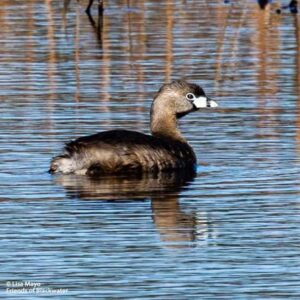 In winter, look for the species on large water bodies where it often congregates into small flocks.
Small grebes are about a foot-long with a distinctive small body. They are stocky, and dull brown. The thick bill is noticeably short and pale, with a dark vertical ring.
Pied-bills dive frequently and were known to do this quickly during market gunning days when hunted for their feathers. They will hide in ample aquatic vegetation with only their bill above the surface, like a periscope, then come out when they think they are safe. This species is part bird, part submarine!
Pied-billed grebes mostly announce their presence with loud, far-reaching calls. And they can nest in moderately to heavily populated areas.
You’ve probably seen one. This species’ nest is a roughly circular floating mass of dead marsh plants and mud anchored to reeds or bushes. Watch the edges of emergent vegetation to easily find one.
Their eggs number 2-to-10 and are pale blue or greenish, and soon stained with mud. Both sexes incubate for 23 days. The downy young leave soon after hatching, to ride on their parents’ backs. There might be 2 broods per season.