
Sale of Meredith Children’s Summer Camp Opposed
The following is courtesy of InDepthNH and comes from our friends at NH LAKES, who remind us of the importance of balancing development with thoughtful planning and advocacy to protect our lakes.
Meredith—May 8, 2026—Lake Winnipesaukee has seen its fair share of summer youth camps converted for luxury house lots in the past two decades, but there are some local individuals and a group fighting the sale of one right now with almost a mile of undeveloped shorefront.
Camp Menotomy for girls, here on Meredith Neck, has been conditionally sold to a local housing developer for $18 million. But supporters of the camp say it can only be sold if the trustees cannot find another camp organization to operate it and argue that there are at least two camp operators willing to lease it.
New Hampshire has a long and storied tradition of hosting summer youth camps on lakes, extending back almost 130 years. A small island on Big Squam Lake, Chocorua Island, was among the very first camps in the nation for boys.
“It was here that organized summer camps began and New Hampshire continues to be the location of some of the finest camps and facilities in America. Our beautiful mountains, lakes, forests and fields are ideally suited for every camping activity imaginable,” the New Hampshire Camp Directors Association website reads.
Camps have had their ups and downs over the years with COVID-19 closing some of them. One major factor has been competing challenges for the land from developers who can pay far more for the shorefront land which has skyrocketed in value in the past 50 years.
If the camps are run as charities, they do not have to pay taxes, however, which have gone up tremendously in the past few decades.
Since the 1930s Camp Menotomy and its predecessor, has been a summer youth camp on 95-acres at 386 Meredith Neck Road. It includes 4,500 feet – almost a mile – of undeveloped, pristine water frontage near the northern tip of the long peninsula into Lake Winnipesaukee and is considered by those who want to preserve it among the few such youth camps left on the 72 square mile “Big Lake.”
Girl Scouts of Eastern Massachusetts operated the camp but did not own the acreage. It is currently assessed at about $15.3 million but has been tax exempt due to annual filings as a charity.
The Town of Meredith could reap large amounts of property taxes if the deal goes through and it is developed for seven separate house lots. Current zoning would allow for about 20 house lots.
The land is owned by a trust which leased to the camp for $1 a year until the camp announced it was closing and would not seek to renew its lease in 2023. In February, 2024, the trust listed the property on the Multiple Listing Service for $20 million. Within hours, it was listed as a contingent sale to Lakes Region Design Group, whose president Jeremy Martin has offered $18 million. It is now a subject of litigation with the sale not finalized.
He did not return a request for comment.
The group’s former publicist for the project, Scott Tranchemontagne, said he is no longer retained. Julie Braverman Bruno, a Boston-based attorney for the Trustees did not immediately respond to a request for comment on the pending sale and the litigation.
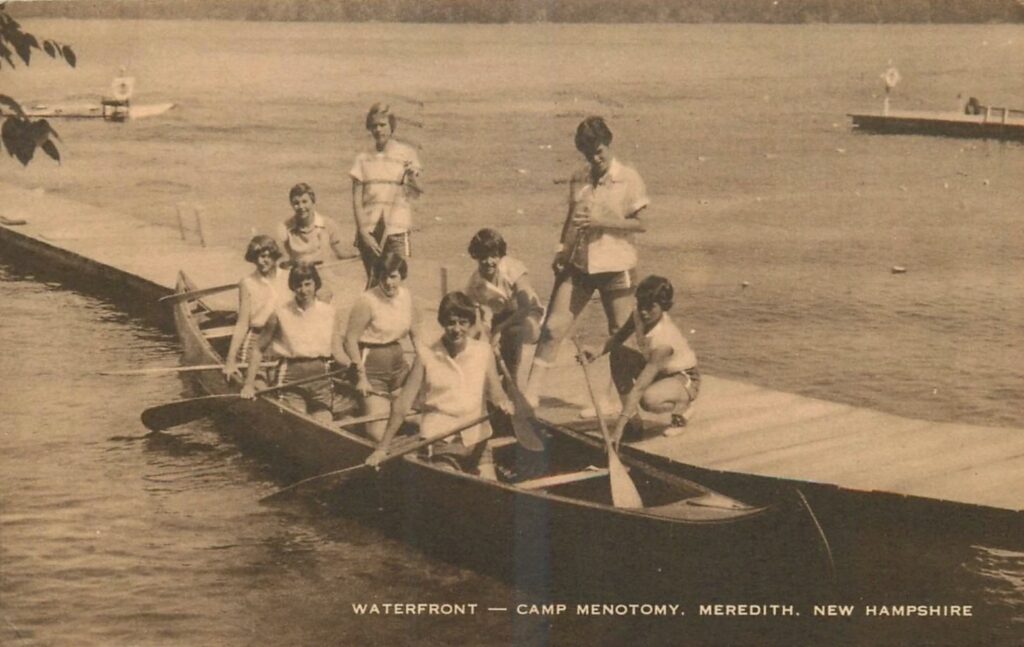
Eric Carlson has made at least two offers for leasing Camp Menotomy. He operates Moultonborough’s Camp Quinebarge. Carlson, along with Jessie Trowbridge, a Camp Menotomy alumna, are named in a request to the Massachusetts attorney general to review the trust. Also, the non-profit Meredith Neck and Islands Alliance, or MerNIA, is fighting the sale. They all point to the deed.
In 1962, the property was placed into the Camp Menotomy Trust, to be managed by a five-person Board of Trustees consistent with the terms of the trust deed.
Bette Higley of Meredith said that since 1966, the Trust leased the camp property to Girl Scouts (formerly the Girl Scouts of Arlington and more recently the Girl Scouts of Eastern Massachusetts) for $1 a year of annual rent. The lease to the Girl Scouts, which was separate from the Trust Deed, had a 100-year lease term which has not yet expired, she said.
The Trust Deed (which is separate from the lease) specified that the Trustees should look to other organizations to use the property as “a camping site” should the Girl Scouts no longer operate a camp on it. Only if no such camp-related users could be found was the property to be sold, it reads.
Higley said COVID-19 closed the camp and other summer camps in the state in 2020, and Camp Menotomy has remained closed.
On May 9, 2023 the Girl Scouts of Eastern Massachusetts gave notice to the Trustees of their lease termination. In February 2024, the property was listed for sale by the Trustees. It spent a day on MLS but the sale paperwork was penned before and on that very same day.
Higley said one camp owner called with an offer when he saw the 2024 MLS listing but never heard back from the realtor. That camp and another camp continue to have interest in renting the property to operate a camp on the property, she said.
Opponents of the sale said the Trustees ignored or rebuffed the offers for two years and have been unwilling to meet with either camp to discuss lease or sale.
The NH Attorney General Charitable Trust office was notified of this attempted sale in 2024 and the Massachusetts Charitable Trust office has been investigating the attempted property sale since 2025. A request for comment from that division of the Department of Justice was not returned.
A formal court petition was filed by the Trustees in Massachusetts on October 14, 2025, in which the Trustees seek Court approval to sell the property for residential development. That matter is still pending.
The two camps interested in leasing it and another interested party filed for participation in the case but were recently denied intervention status, though appeals are anticipated, Higley said.
MerNIA submitted numerous letters to the NH Attorney General Charitable Trust Office and one to the Massachusetts Attorney General’s office in support of the camps seeking to continue to fulfill the terms of the Trust by continuing to operate a camp on the property, but MerNIA has not participated in the Massachusetts court case, she said.
Attorney Adam Hamel sent the letter to the Massachusetts Attorney General’s office on behalf of MerNIA and he has also represented two of the interested parties who sought to intervene in the Massachusetts lawsuit filed by the Trustees.
In an April 7 letter to its Deputy Chief Emily Gabrault, attorney Hamel, wrote that the leased camp cannot be sold if there is a willing camp to take over operations. It cited deed restrictions recorded at Belknap County in 1962. That document, in part, reads:
“In the event that the time comes when there shall be no organization known as the Arlington Girl Scouts, or the same organization under a different name, or any successor organization of like purposes in Arlington to utilize the site for camping purposes, then the trustees by unanimous consent may sell the property herein-above conveyed, together with all personal property then in the hands of the trustees, for such price, upon such terms and to such person, persons or organization as may to them seem proper,” the deed reads.
“In the event that such property aforesaid shall be sold by the said trustees they shall invest the proceeds of such sale in such investments as shall be lawful for Massachusetts judiciaries and shall utilize the income therefrom for campership or scholarships for girls of Arlington….”
What is being Lost or Gained by the Sale?
There are environmental and human impacts to a sale in addition to impact on taxes for municipalities. For the municipalities that have hosted these camps but reaped no benefit to help the tax base due to state law which allows for operating charitable camps who file annually by statute, it is time to cash in and perhaps provide some property tax relief to other property owners in the municipality.
Andrea LaMoreaux, president and policy advocate for NH LAKES, which represents most all lake associations, said converting summer camps to housing can change land use, often increasing the potential for water quality impacts if not carefully managed.
“Camps typically concentrate use in certain areas while leaving large portions of shoreline and upland forest intact, which helps absorb runoff water and limit nutrient inputs. Subdivisions, by contrast, tend to distribute homes, septic systems, and infrastructure more evenly across the landscape, which can increase impervious surfaces and reduce natural shoreline buffers. These factors may contribute to higher inputs of phosphorus, nitrogen, and sediment and decreased water quality if no additional protections are in place,” she said.
“At the same time, well-designed residential development can minimize these risks. By incorporating lake-friendly practices, such as preserving or restoring vegetated shoreline buffers, clustering homes to protect open space, minimizing impervious surfaces, and using advanced or shared wastewater systems, developers can significantly reduce impacts on water quality. Thoughtful planning and design offer an opportunity to balance growth with long-term lake health, helping ensure that shoreline properties remain both desirable and environmentally sustainable,” LaMoreaux said.
Ken Robbins, who in 2020 wrote an op-ed to the NH Union Leader as director of Camp Kabeyun, a 97-year-old residential summer camp in Alton Bay, and as president of the New Hampshire Camp Directors Association, which represents 160 licensed camps in the state said there are profound changes and losses to the campers when a camp is closed.
He said over 150,000 young people who had camped in New Hampshire could not do so that year due to the pandemic. He said millions of dollars and countless jobs were lost and “without direct and measurable support, the survival of this vital industry and cherished tradition is in serious doubt.”
He explained camps emerged in the 1800s, as the country became increasingly urbanized and industrialized, to safeguard a connection to and appreciation of the outdoors.
“That need has only increased. Today, camps are our children’s respite from busy schedules, academic expectations, and ever-present technology,” he wrote.
For children, Robbins wrote, opportunities for foundational social and emotional development are lost, such as independent decision-making and self-reliance, environmental conservation and stewardship, and principled and ethical participation in communities.
And as families continue to struggle to find meaningful and affordable childcare, camps are closing.
“None of this is hyperbole. These are the thoughts oft-repeated in families’ letters to New Hampshire camp directors, as camps announced they could not open, whether out of an abundance of caution, economic infeasibility, or state guidelines that are profoundly incompatible with a given camp’s programming,” Robbins wrote.
“There is no doubt camps are a critical component of the network of care that New Hampshire families rely on,” he concluded
InDepthNH protects independent journalism that holds government accountable to the people. Our investigative reporting prompts civil discourse that spurs citizens to action. We reveal wrongdoing, corruption and influence-peddling while giving voice to the disenfranchised. InDepthNH fulfills the press’ watchdog role as envisioned by the founders of our democracy.