
Owner of Sunk Truck Has 48 Hours to Remove it from Lake Winnipesaukee
Editor’s Note: The following story, from the Laconia Daily Sun via NH LAKES, raises questions about the need for new legislation in regard to vehicles falling through lake ice. The last reported incident of a vehicle breaking though Ossipee Lake’s ice was in January, 2010, when two trucks fell through.
Gilford—April 17, 2026—The owner of a truck that went through the ice of Lake Winnipesaukee in mid-March was given a 48-hour deadline — that expires Saturday — to remove it from the water, otherwise staff of the New Hampshire Department of Environmental Services will have it removed, on the owner’s dime.
“He basically is on the hook if we have to remove it,” said NH DES Public Information Officer Jim Martin on Thursday. “We will seek cost recovery from him, and depending on how that goes, it depends on the owner of whether that turns into a legal matter or not.”
The truck, a Honda Ridgeline owned by a Gilford resident, according to NH DES, went through the ice on March 13, and sunk in an area near Dockham Shore about 50 feet deep.
NH DES staff said there was no visible sheen to indicate gas or oil leaking. Conservation Officer Chris Bryson of NH Fish and Game provided the owner with contacts for organizations to help remove the vehicle at the time the incident occurred.
Martin said March 16 that a local contractor deployed a submersible drone with a camera, and there did not appear to be any leaks. Ice conditions were not stable then, and the contractor told NH DES staff they needed to wait until conditions improved for a recovery effort with divers. It would likely need to have inflatable bags attached to raise the truck to the surface, to be towed to a ramp.
Since there were no leaks visible, NH DES staff chose not to fine the owner. Martin said on March 16 that as long as the owner was taking necessary steps to cooperate, a fine is not issued, but the owner is financially responsible for removal.
While it was recommended to leave the truck until ice-out due to safety concerns, Bryson said in the days following, there were efforts made by the owner to remove the truck of which he would not approve.
The Gilford Selectboard discussed the issue on April 8, where members voiced their disappointment in the makeshift process the owner had undertaken in attempting to remove the pickup, using the town beach as a base.
Town Administrator Scott Dunn went to the beach when he learned of the effort, spoke to the owner, and told him he was not allowed to bring the truck onto the beach, out of concern it could potentially become an environmental hazard.
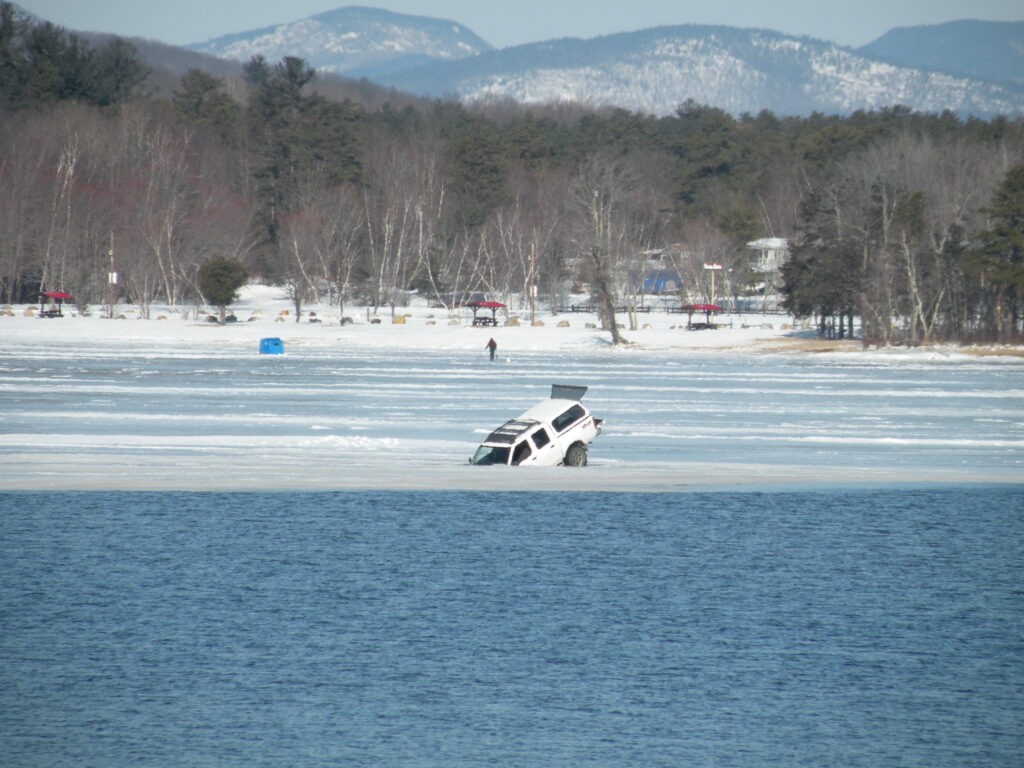
At that meeting, board members spoke about how the owner and others helping were making an array of attempts to remove the vehicle, including attaching a winch to a tree to pull it in. In the days that followed the sinking, Bryson said there were also attempts made to use a chainsaw to create a path to drag it to shore. He called it a “high-risk mission” he didn’t recommend.
Town leaders saw there was a lack of progress and became concerned, as efforts managed to move the truck from Dockham Shore to about 0.75 miles off the coast of Gilford Town Beach.
After the April 8 meeting, Dunn contacted Executive Councilor Joe Kenney, asking him for his assistance.
Kenney told The Daily Sun on Thursday he spoke with DES Commissioner Robert Scott, and Mike Wimsatt, waste management director for DES, about the process moving forward.
“Obviously, safety is paramount with this kind of retrieval,” Kenney wrote in an email on April 13, to Dunn. “I believe DES is waiting to make sure that no ice will interfere with getting the vehicle out of the lake. The owner has the option first, if he cannot remove it, then DES will set up an arrangement to retrieve it.”
A special meeting of the Gilford Selectboard was held Wednesday afternoon, where Clerk Richard Grenier said a 3-0 vote was taken to allow NH DES staff to use the beach for recovery, but not to allow any equipment.
NH DES staff were not present at the meeting, but Deputy Chief Brad Ober, Tom Francoeur of the Gilford Recreation Commission, and Recreation Director Matt Mansur were there.
Grenier said there was concern about the use of the beach by all parties.
“There was much discussion back and forth about how this was going to be done, and our push was that obviously DES is going to hire a subcontractor,” Grenier said. “There was a big debate about airbags and a barge, all kinds of stuff, and ultimately, we were concerned about the use of the beach in any way.”
Grenier said the opinion was that at some point, when the truck gets in shallow water, whatever it dragged up will be underwater, and on the sand. They also didn’t want to have a truck backed up on the beach, as anything leaking would cause a mess on the beach, as well as the roadway leaving the area.
“We felt that if they brought it to Glendale with a concrete ramp and pavement, when they dragged it out, DES could put down absorbent material if need be to keep it out of the lake,” Grenier said.
There were several motions made, Grenier said, because there was a question about the wording of the NH DES response. This included allowing NH DES staff to use the beach for “divers and equipment.”
“We said define ‘equipment,’ that’s a broad statement,” Grenier said. “So, we said personnel only. We don’t care if DES is down there with a radio and a pair of binoculars.”
Grenier said after about a half hour, the vote was unanimous, to only allow NH DES staff to use the beach without equipment. He noted every homeowner on the lake has a pair of binoculars, and someone on the recreation commission acknowledged a resident of Dockham Shore has been watching every day, and contacting them.
“The opinion was that people see the truck taken out on the beach, and after that article in the paper, even if it is done professionally, it won’t look right,” Grenier said. “We thought there were too many threats to the beach, in one form or another. It needs to be taken care of through Glendale.”
Martin said the 48-hour removal window ends April 18.
Throughout Thursday, a boat with the insignia “Divemaster Dive Services” could be seen off the coast of Gilford Town Beach. The boat was no longer there on Friday morning.
An issue before the governor
Kenney brought the matter up at the Governor and Executive Council Meeting on Wednesday, in front of Gov. Kelly Ayotte. He said 20 years ago, he was serving in the state Senate, and sponsored a bill that became law requiring removal of any gas-powered vehicle from the water within 48 hours.
Kenney said in the meeting the owner probably “tried his darnedest” to remove the vehicle himself in an affordable manner, but that likely will not work. He said the state would then step in to remove the vehicle, and pass the cost onto the owner.
Scott replied to Kenney that the truck needs to be removed within 48 hours, but also safely, and this was the reason they waited until ice-out. On April 13, NH DES staff evaluated the area for safety, then notified the owner about the 48-hour timeframe.
“Should the owner not be able to do that, we will engage a contractor as the agency, have it removed, and then historically, we would be charging them for the efforts,” Scott said in the meeting.
Kenney told Scott he is getting the sense the owner doesn’t have the money to remove that truck. He anticipates legislators in the Lakes Region following the outcome, and thinking further legislation needs to be passed, to prevent the state picking up the cost.
“Because, if they can’t afford car insurance, they probably can’t afford to pay the state,” Kenney said. “So, get ready for the legislation to come at the department next year.”
“Potentially,” Scott replied.
Kenney told The Daily Sun on Thursday, this is something taken very seriously by state leaders. He added he can commiserate with the owner, and knows it is an unfortunate situation, but “it is the law.”
“You need to understand the unique circumstances that could happen,” Kenney said. “It could be topography, ice, weather conditions, but it is a guide to say that you need to get the vehicle out as soon as possible, because it is an environmental matter that isn’t good for our lakes.”
Comments (2)
Comments are closed.
Gilford’s leadership is clearly focused on protecting its town beach and ensuring accountability for any contamination in to the lake or on to a publicly used beach. That makes the lack of follow-through in Effingham–Ossipee all the more concerning. In 2021, residents raised concerns that soil from beneath a former gas station—a potentially contaminated source—was dumped to the Ossipee Lake Camping Area, involving multiple parties connected to the project. Despite those concerns being brought to local officials countless times over the years, there does not appear to ever have been a meaningful public investigation or clear effort to establish accountability. Instead, the issue seems to have been quietly set aside. Good for Gilford for acting responsibly and transparently.
Megan,
A truck clearly sinking to the bottom of the lake is a little different than an alleged pile of contaminated dirt.
Of course Gilford took action. There was hard evidence